
Search Louisiana Criminal Court Records
Louisiana criminal court records are maintained by the Clerk of Court in each of the state's 64 parishes. These records cover felony and misdemeanor case filings, charging documents, court minutes, judgments, and case dispositions from district courts, parish courts, and city courts statewide. Every criminal case filed in Louisiana creates a public record held at the parish level. You can search Louisiana criminal court records online through statewide portals, in person at any parish courthouse, or by written request to the clerk's office. This page covers where to look, what to bring, and how access works across the state.
Louisiana Criminal Court Records Quick Facts
How to Search Louisiana Criminal Court Records
Two statewide portals give you broad access to criminal court records from multiple Louisiana parishes in one place. The first is eClerks LA, run by the Louisiana Clerks Remote Access Authority. Its portal provides a free statewide index search covering all 64 parishes. You can search adult criminal records at no cost through the dedicated criminal search feature. Case monitoring is also free. Set up alerts and get a text or email each time a new document is filed in a case you are tracking. That monitoring covers all 64 parishes from one login. Paid subscriptions unlock document images and printing at the parish level. eClerks LA also handles e-filing and e-recording for parishes that participate in the program.
The eClerks LA statewide portal is operated by the Louisiana Clerks Remote Access Authority and connects users to records from all 64 Louisiana parishes through a single account.
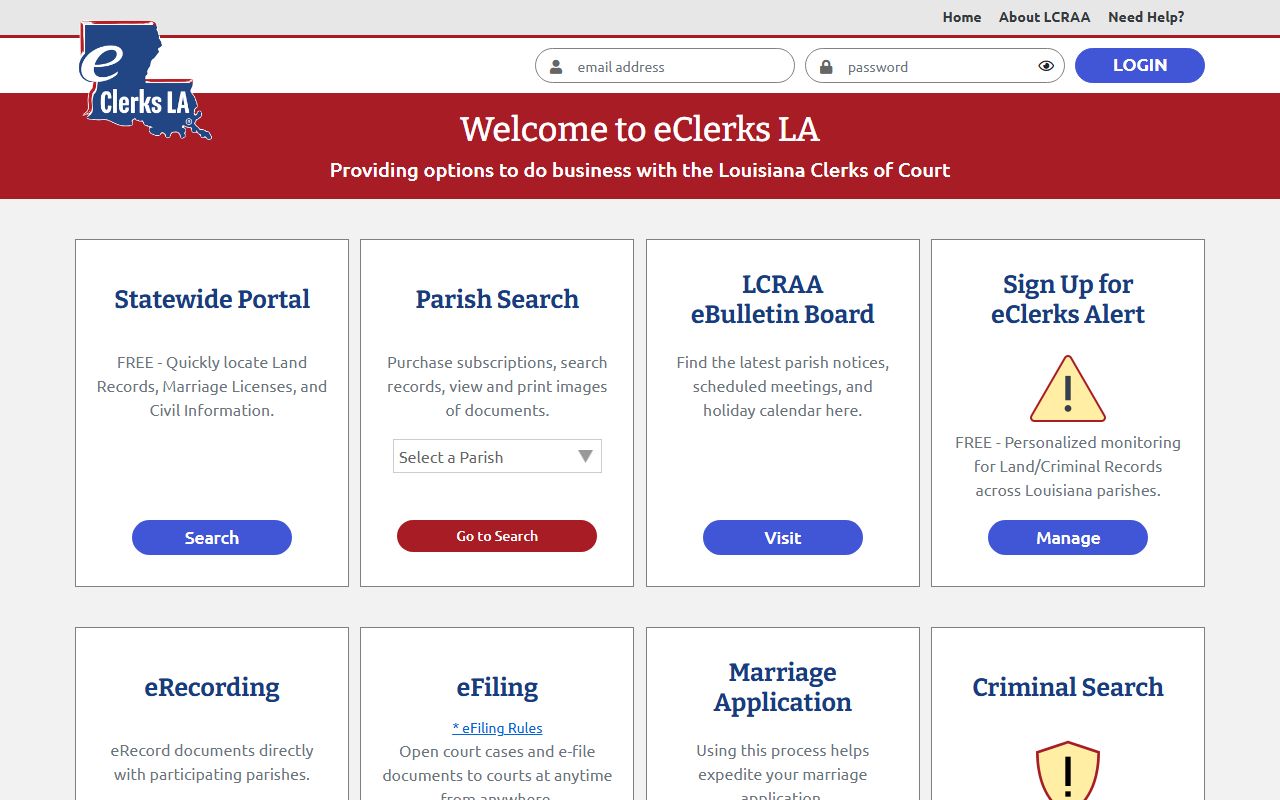
The eClerks Alert feature lets you monitor up to five names across all 64 parishes at no charge, with notifications by text or email whenever new activity is recorded.
Clerk Connect is the second major multi-parish platform for Louisiana criminal court records. It supports searches in Allen, Bossier, Caddo, East Baton Rouge, Jackson, Lafourche, Lincoln, Natchitoches, Richland, and other participating parishes. A subscription is required for full access. Daily, monthly, and yearly plans are available at different rates depending on the parish. Searches can be run by defendant name, case number, or filing date. Docket entries, case summaries, and certain filed documents are available depending on what the parish has loaded. E-filing is also supported through Clerk Connect for East Baton Rouge, Lincoln, Ouachita, St. John, Caddo, Bossier, and Lafourche parishes. Anyone pulling records from several parishes regularly will find a subscription saves considerable time over contacting each clerk individually.
The Clerk Connect portal serves multiple Louisiana parishes under a single subscription, making it useful for anyone who needs criminal court records from more than one location.
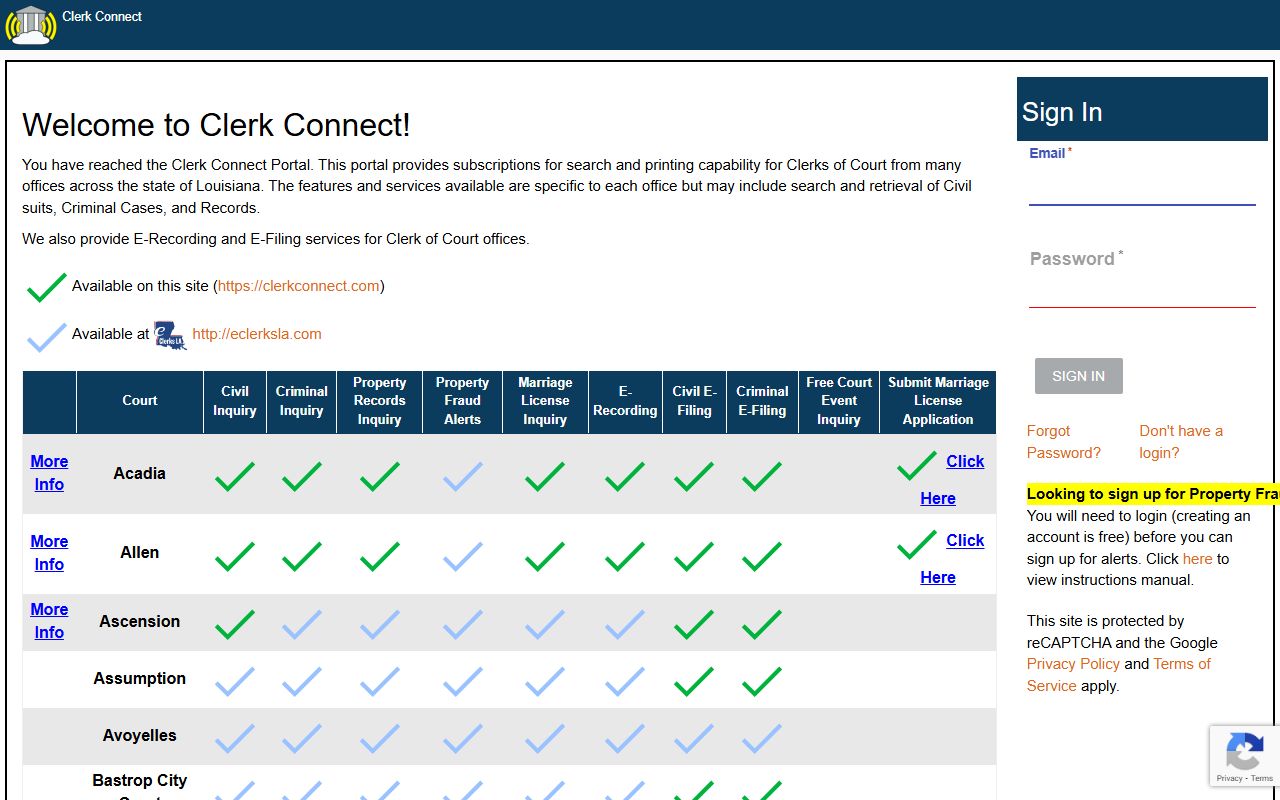
Clerk Connect also supports e-filing for several of its participating parishes, allowing attorneys and parties to submit documents electronically to the court.
In-person searches are available at any parish clerk's office. Most offices are open Monday through Friday from 8:30 AM to 4:30 PM. Bring the defendant's full name and the year the case was filed. A case number helps. Copy fees are typically $1.00 per page for plain copies, and more for certified documents.
Louisiana State Police Background Checks
The Louisiana State Police Bureau of Criminal Identification and Information serves as the state's central repository for criminal history records. This role is established under La. R.S. 15:578. The Bureau maintains the Louisiana Computerized Criminal History database, known as LACCH. Its Internet Background Check system, called IBC, is available at ibc.dps.louisiana.gov. Authorized organizations can run electronic background checks through this portal. The Bureau's main office is at 7919 Independence Blvd in Baton Rouge. In-person requests are accepted Monday through Friday from 8:00 AM to 3:30 PM, excluding holidays. The phone is (225) 925-6095. A state background check costs $31. Fingerprinting at LSP headquarters adds a $10 fee. An FBI check adds $12 more where authorized.
The Louisiana State Police Internet Background Check system provides electronic access to the statewide criminal history database for authorized agencies and organizations.
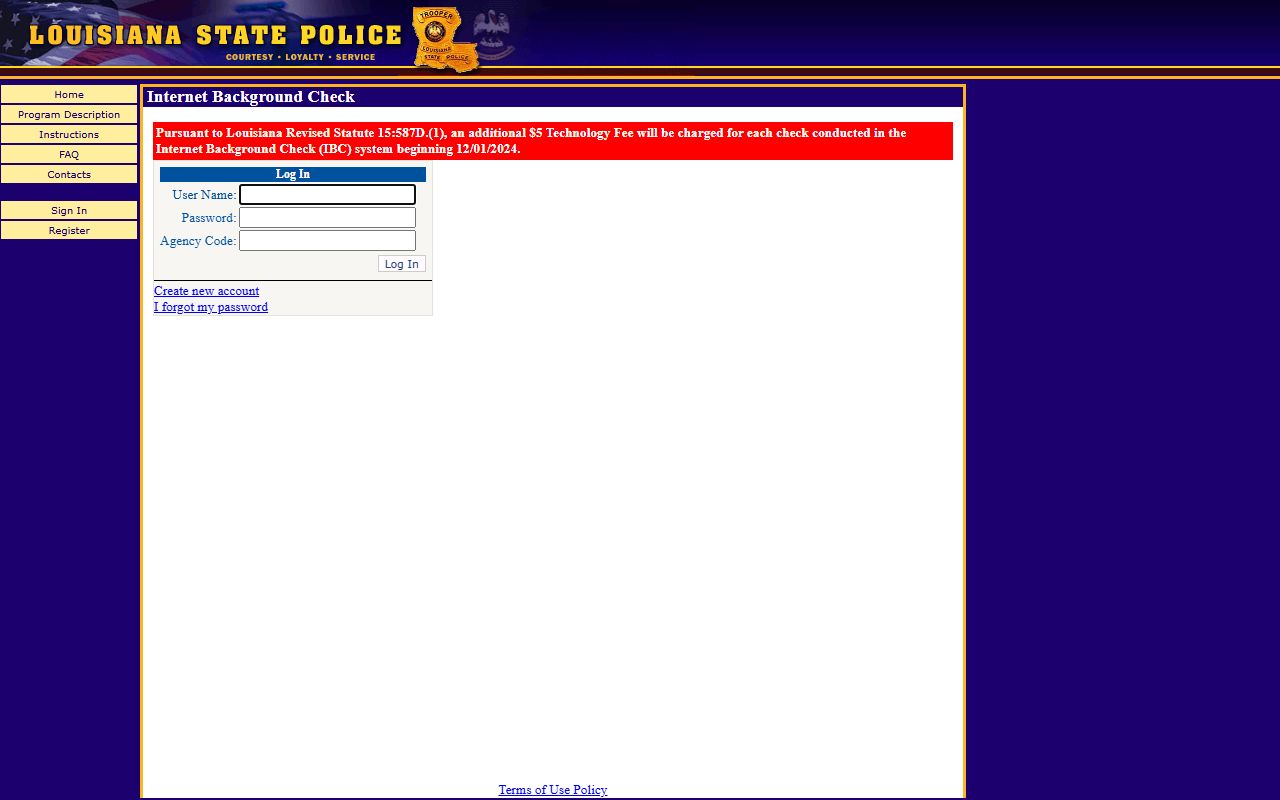
The IBC system runs 24 hours a day, seven days a week, with maintenance downtime from 7:00 AM to 4:00 PM on Sundays.
Louisiana is a closed record state under La. R.S. 15:587. Criminal history records from the State Police are only available to agencies and persons authorized by law. Health care providers, day care facilities, the Department of Justice, the Department of Labor, and public housing commissions are among the authorized user types. The general public cannot obtain a certified criminal history report from the State Police for personal use. This restriction applies specifically to the LACCH database. It does not block access to case records at the Clerk of Court, which are governed by separate public records rules under La. R.S. 44:1.
Individuals can request their own criminal history through a Right to Review. Submit it in person with a $31 money order and valid ID, or by mail with a $31 money order, fingerprints, an authorization form, and a rap disclosure form. The mail process takes 15 to 21 business days.
Department of Corrections Offender Lookup
The Louisiana Department of Corrections offers a free public offender search at doc.louisiana.gov/offender-search. Search by name or DOC number to find anyone currently in state custody. Results show the facility, the offense, and the projected release date. No account is needed and there is no fee. This covers only people under state supervision. It does not include parish jail populations. Parish jails are run by the sheriff in each parish, and their inmate rosters are kept separately. Many sheriffs now post their inmate lists online, but coverage varies by parish. For someone held in a local jail, contact the sheriff's office in that parish directly.
The DOC database updates on a regular basis. Supervision status is included in search results. It is a solid first stop when looking for a person who may be serving a state sentence in Louisiana.
Federal Criminal Court Records in Louisiana
Federal criminal cases in Louisiana go through one of three federal district courts. The Eastern District covers New Orleans and the southeastern parishes. Its site is laed.uscourts.gov. The Middle District covers Baton Rouge and the central region at lamd.uscourts.gov. The Western District handles Shreveport, Alexandria, and the northern and western portions of the state at lawd.uscourts.gov. Federal cases are separate from state criminal matters. They cover offenses under federal law such as drug trafficking across state lines, federal firearms charges, mail fraud, and immigration violations.
The Eastern District of Louisiana handles federal criminal cases from the New Orleans metro area, including Orleans, Jefferson, St. Tammany, and surrounding parishes.
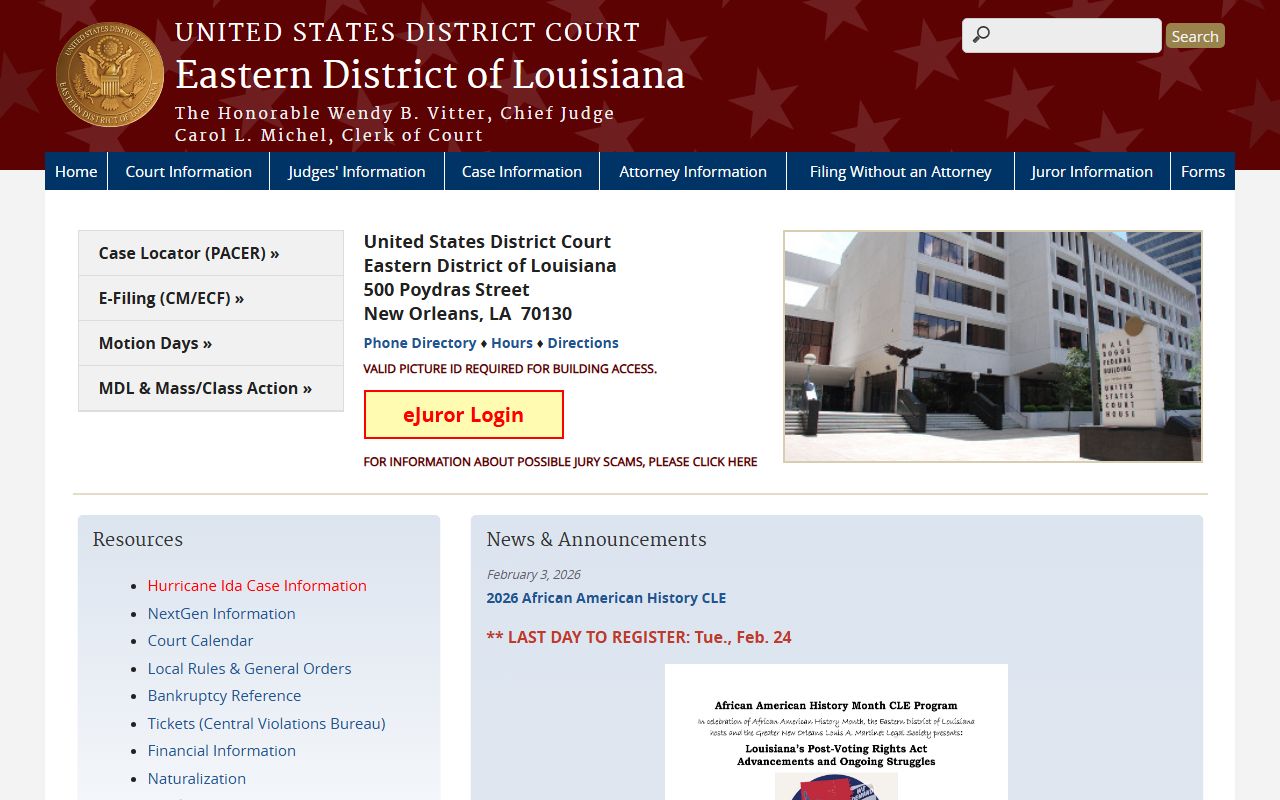
The Eastern District also handles appeals from the Eastern District and maintains its own case management system accessible through PACER.
The Western District of Louisiana covers a large area of the state with court divisions in Shreveport, Alexandria, Monroe, Lafayette, and Lake Charles.
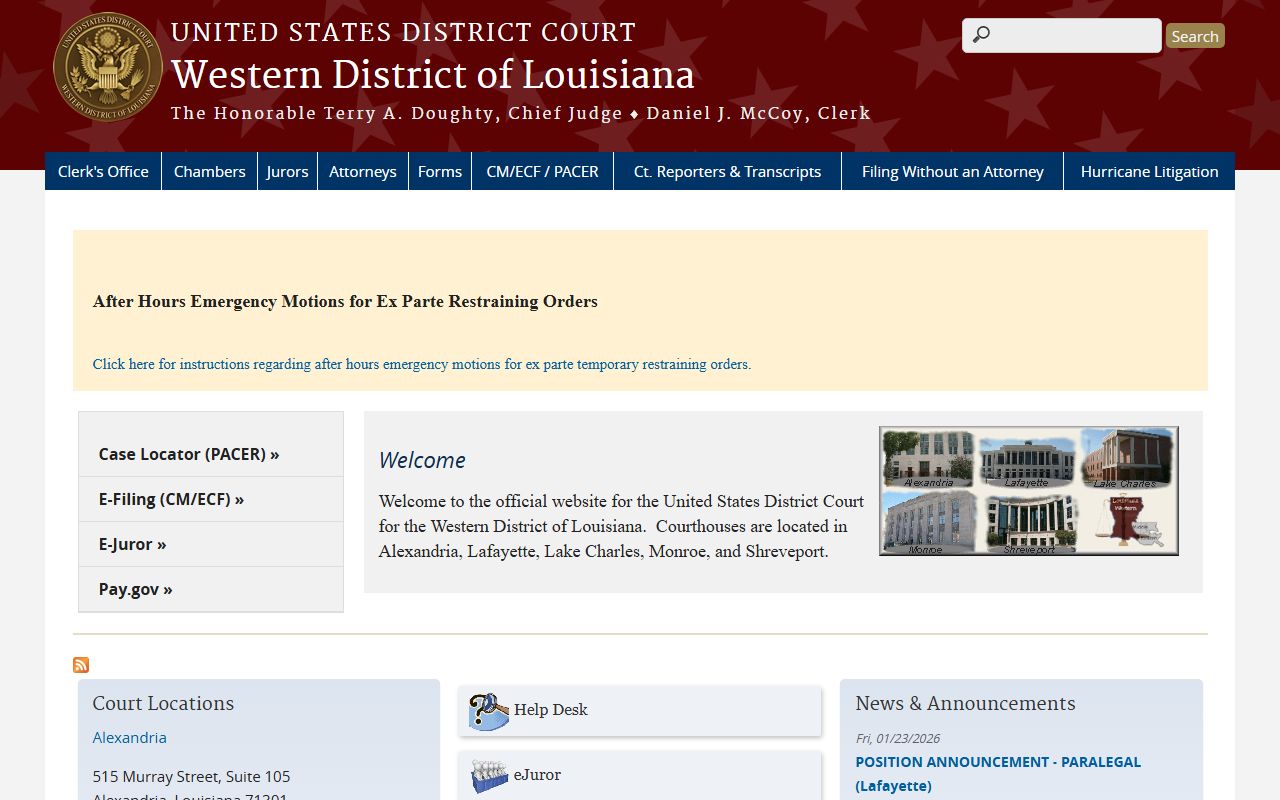
The Western District covers the vast northern and western portions of Louisiana, serving many of the state's rural and mid-size population centers.
All three federal districts are searchable through PACER, the Public Access to Court Electronic Records system. Registration is free. The per-page charge is $0.10 with a $3.00 cap per document. Quarterly fees below $30 are waived entirely. PACER includes the full federal case file: indictments, pretrial motions, plea agreements, and sentencing documents. Running searches on both PACER and eClerks LA gives the most complete coverage of both federal and state criminal matters in Louisiana.
The PACER system provides access to federal court records from all three Louisiana federal districts under a single account, with per-page fees waived for low-volume quarterly users.
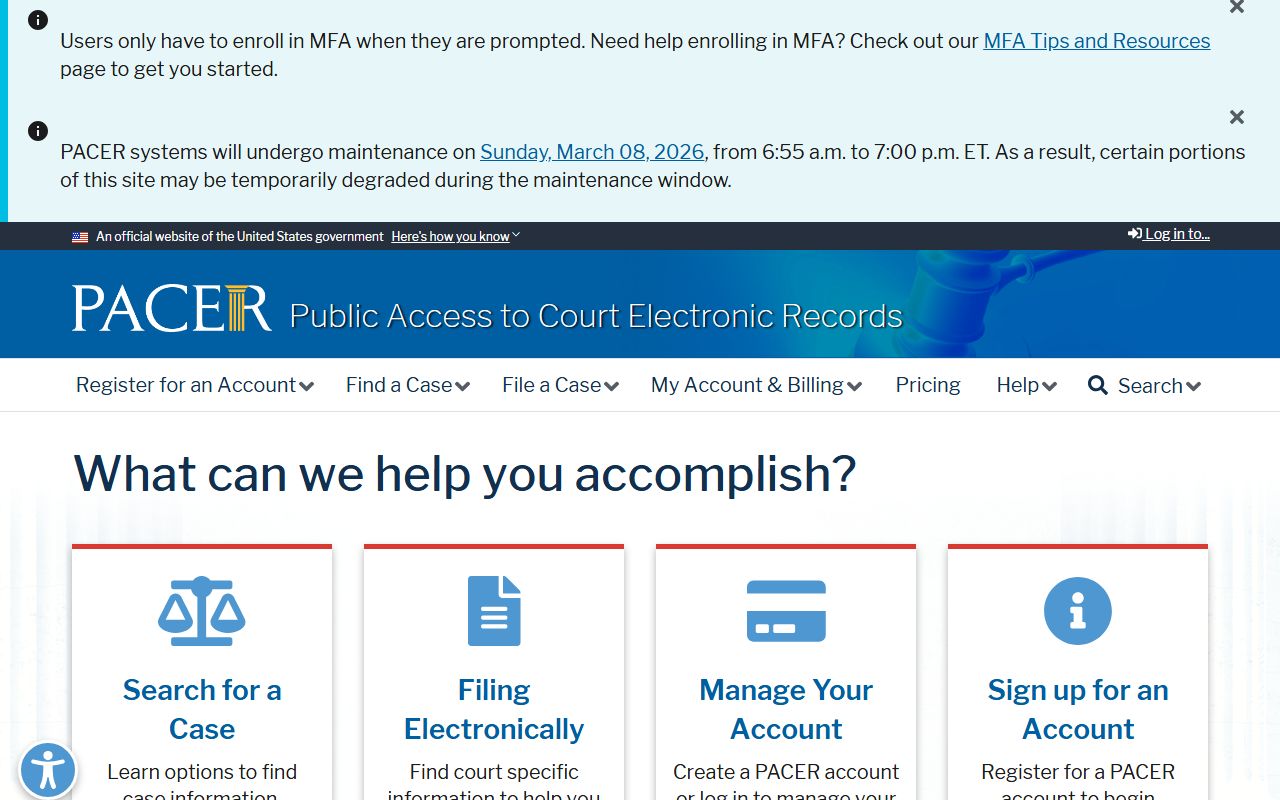
PACER covers federal courts across the country, so the same login works for all Louisiana federal districts and any other federal court you may need to search.
Types of Criminal Court Records
Criminal court records in Louisiana cover several document types. Charging documents include indictments, bills of information, and arrest warrants. These papers begin the criminal case and describe what the person is accused of doing. Court minutes capture everything that happens at each scheduled hearing: pleas entered, motions argued, rulings handed down, and continuances granted. Sentencing documents show the penalty the judge ordered after a conviction or plea. Bond and bail papers are also kept in the case file. All of this is maintained by the Clerk of Court in the parish where the case was filed. For the most complete picture of any Louisiana criminal case, the full file at the clerk's office is the place to start.
Louisiana law sets minimum retention periods. Felony case records are kept permanently under La. R.S. 44:36. Misdemeanor records must be held for at least 10 years after the final disposition. Traffic records are kept for 3 years unless the offense involved a serious injury or death. Some parishes have digitized older records. Others keep older files at offsite archives. Call the clerk's office ahead of time to confirm whether specific records are on-site or at an archive location before making the trip.
Common documents in a Louisiana criminal case file include:
- Bill of indictment or bill of information
- Arrest warrant or bench warrant
- Court minutes from each hearing
- Motions filed by prosecution and defense
- Plea agreement if applicable
- Judgment and sentencing order
- Bond documents and release conditions
Juvenile records are sealed and never available through a standard public records request. A court order is required to access them. This rule applies in all 64 Louisiana parishes without exception.
Who Can Access Louisiana Criminal Records
The Louisiana Public Records Law at La. R.S. 44:1 defines public records broadly to include all documents prepared in the conduct of public business. Criminal court case files fall within this definition. Under La. R.S. 44:32(A), the record custodian must present any public record to any adult who asks for it. Being a party to the case is not required. No reason needs to be given. Viewing records at the courthouse costs nothing. Copy fees apply separately. The Louisiana Supreme Court, located at 400 Royal Street in New Orleans, oversees the state's court system and its Clerk's Office is open Monday through Friday, 8:30 AM to 4:30 PM, reachable at (504) 310-2300.
The Louisiana Supreme Court sets rules that govern how court records are maintained and accessed across all 64 parishes in the state.
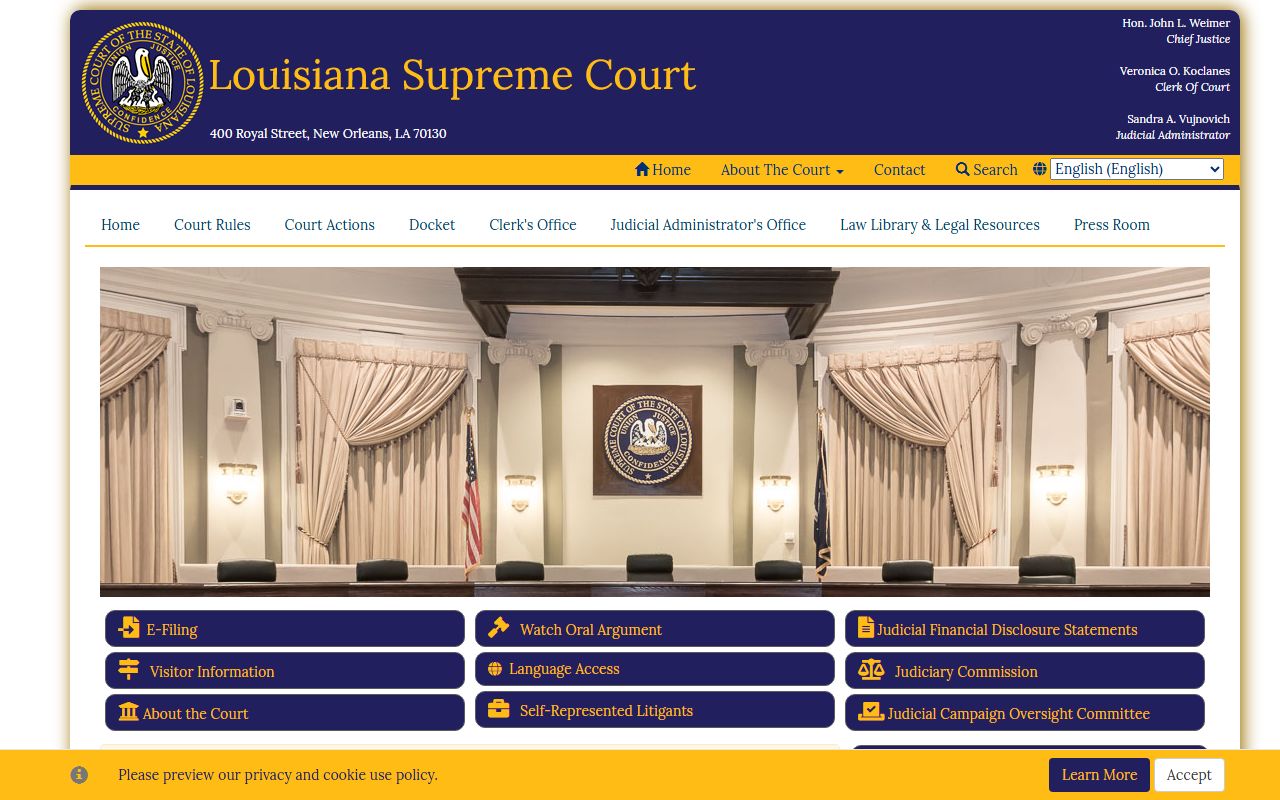
The Supreme Court also handles appellate jurisdiction over all district court decisions in Louisiana and publishes opinions and rules affecting court record access statewide.
Several exceptions apply. La. R.S. 44:3 lists exemptions that can block public access to specific records. These include active investigation materials where disclosure could harm the investigation, and records with certain personal identifying information. Juvenile records are always sealed. Records expunged under La. C.Cr.P. Art. 971 are removed from public access after the court grants the petition. Judges can seal specific documents after a hearing showing good cause. Most criminal court records, though, remain open to public inspection. Note: the State Police acknowledges roughly 80% of its criminal history records lack a complete final disposition, so Clerk of Court files are generally more complete for case-level research.
Louisiana Expungement of Criminal Records
Louisiana law allows some people to have criminal records removed from public access through expungement. The governing statutes start at La. C.Cr.P. Art. 971. Under Art. 977, a person arrested but not convicted may petition to expunge that arrest record. Art. 893 allows expungement of certain felony convictions dismissed under its terms. Art. 894 applies to qualifying misdemeanor dismissals. After a court grants an expungement, the record is removed from public databases. It may still exist in restricted law enforcement systems that are not open to the public. Most people file an expungement petition with the help of an attorney, as the process involves multiple agencies and a court hearing.
Expungement fees in Louisiana are paid separately to each involved agency. The Clerk of Court charges $200. The Bureau of Criminal Identification and Information charges $250. The District Attorney charges $50 and the Sheriff charges $50 as well. A DWI conviction adds another $50 fee through the Office of Motor Vehicles. Total costs run past $550 before any attorney fees. La. C.Cr.P. Art. 983 created an automatic expungement process for qualifying cases, though that provision depends on available state funding for implementation.
Louisiana Sex Offender Registry
The Louisiana Sex Offender and Child Predator Registry is a free public database run by the Louisiana State Police. Search it at lsp.org/sex-offender-registry by name, address, or mapped geographic area. Each listing includes the registrant's photo, conviction details, and current home and work address. No account is needed and there is no fee. Results reflect the most recent information reported to the State Police by the registrant. Louisiana law requires registered offenders to update their information on a set schedule. Violations of those registration requirements are criminal offenses on their own.
Browse Criminal Court Records by Parish
Each of Louisiana's 64 parishes has a Clerk of Court who maintains criminal case files for cases filed in that area. Pick a parish below to find local courthouse contact info, online search tools, and details for that clerk's office.
View All 64 Louisiana Parishes
Major Louisiana Cities with Criminal Court Records
Residents of major Louisiana cities have their criminal cases filed at the district court for their parish. Select a city below to find the courthouse that handles records for that area and learn how to search for case information.